Most new players pick up a paddle and start hitting within minutes. The confusion begins when someone calls out "four, two, one" before serving, and half the court looks puzzled.
The good news? The core pickleball rules are short and logical. Learn the serve, the two-bounce rule, the kitchen and the score call, and you can play a proper game. This guide explains each one in plain English, based on the USA Pickleball Official Rulebook, which most clubs and tournaments follow.
How Pickleball Rules Shape Every Rally
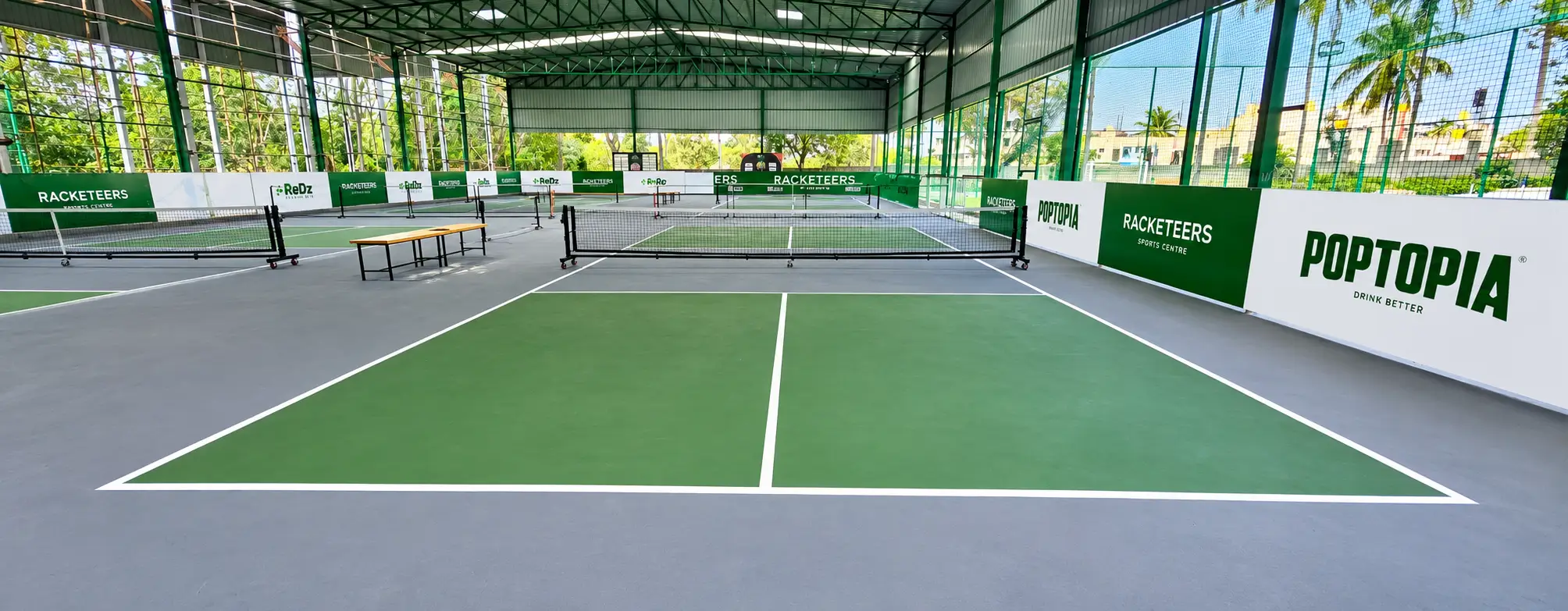
Pickleball is played on a court 20 feet wide and 44 feet long, for singles and doubles. A net splits it in half. A 7-foot zone on each side of the net is the non-volley zone, better known as the kitchen.
The aim is to outlast your opponent in each rally. A rally ends when the ball lands out, fails to clear the net, or bounces twice before someone returns it.
Two pickleball rules for beginners cause more faults than any others.
The Two-Bounce Rule
After the serve, the receiving side must let the ball bounce before returning it. The serving side must then let that return bounce too. Only after these two bounces can either side volley, which means hitting the ball before it lands. This stops servers rushing the net.
The Kitchen
You can't volley while standing in the kitchen or touching its line. Momentum counts as well. If you volley and your feet then carry you into the zone, it's a fault.
Pickleball Serve Rules: Start Every Point Cleanly
Every point begins with an underhand serve, hit diagonally across the court. The pickleball serve rules ask for three things on a standard volley serve: contact below your waist, the paddle head below your wrist, and an upward swing. Since the 2026 update, each of these must be clearly met, so a borderline serve is now called a fault.
Both feet must stay behind the baseline at contact. The serve has to land in the diagonal service box, past the kitchen line. Landing on that line is a fault.
Struggling with the volley serve? Try the drop serve: let the ball bounce, then hit it. You get one attempt, and a serve that clips the net but lands in the right box is played on.
Pickleball Scoring Rules, Made Simple
In traditional play, only the serving side can win a point. If the receivers win the rally, they don't score.
The pickleball scoring rules for doubles use three numbers: your score, the opponents' score, then server one or two. Both partners serve before the serve passes across, which is called a side-out. The exception is the first turn of the game, when only one player serves. That's why every game starts at "0-0-2".
Here's an example. You call "5-3-1" and win the rally. You swap sides with your partner and serve again at "6-3-1". Lose the next rally, and your partner serves at "6-3-2".
Some leagues use rally scoring instead, where every rally earns a point. This scoring guide from Pickleball.com compares both systems.
Ready to Put the Rules into Play?
Reading the pickleball rules is a start, but they only click after a few real games. Call the score out loud, watch your feet near the kitchen and count those two bounces.
Racketeers in Whitefield-Varthur, Bangalore, is a friendly place to practise. Drop into a Pickleball Open Play session to meet other players, sign up for coaching, or book a court and bring your own group.
GET YOUR GAME STARTED
Ready to try pickleball? Find your next game at Racketeers and put the rules into practice.
BOOK YOUR COURT